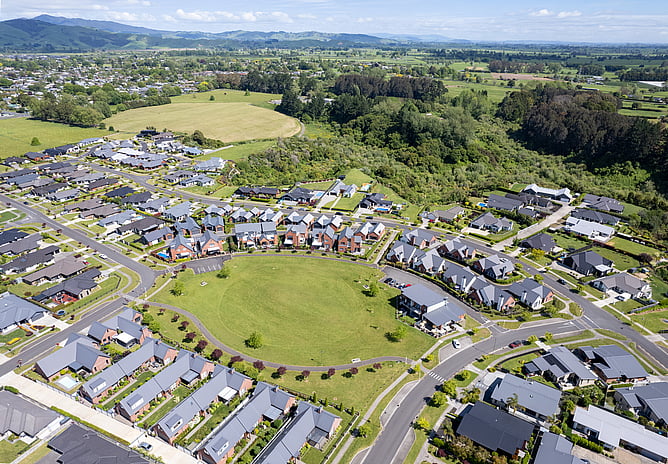
On a quiet afternoon, Cambridge Park reveals itself best on foot.
The edges are soft. Streets feel scaled for people, not just cars. There’s a sense that the neighbourhood knows where it sits in the wider fabric of Cambridge, edging naturally alongside the Town Belt, within easy walking distance of Cambridge township and Leamington, and open rather than turned inward.
That feeling was intentional.
Twenty years ago, as Cambridge began to grow beyond its traditional boundaries, the land that would become Cambridge Park was still zoned rural, earmarked for future residential use, but requiring a plan change before development could proceed.
Rather than treating subdivision design as something to apply at the end, the developers brought architects and landscapers to the table early, asking PAUA Architects a central question: how could Cambridge grow while still feeling like Cambridge?
From the beginning, Antanas Procuta, director and principal architect at PAUA Architects, says the focus was not only on people, but also on the existing Cambridge townscape pattern.
“Streets were conceived as shared spaces rather than vehicle corridors. Public spaces weren’t left over; they were central to the design,” Antanas explains.
“The intent was to reclaim streets as places to live, not just pass through.”
One of the defining ideas, he says, was the use of a natural boundary with a clear edge, respecting the relationship with the Cambridge Town Belt while creating a neighbourhood that felt anchored rather than sprawling.
“At both a micro and macro level, it was about placemaking,” Antanas says. “That is, how individual homes relate to streets, and how the whole area connects back to the town.”
At the heart of Cambridge Park sits The Oval, a shared green that was always intended as a social centre, not a feature to admire from afar. Higher-density housing, a cafe and communal open space were planned together, reinforcing the idea that neighbourhoods work best when people have a public space and reasons to meet.
That commitment to walkability and connected design was formally recognised in 2009, when Cambridge Park and PAUA Architects received the Living Streets Aotearoa Golden Foot Walking Award.
“At that time, we were incredibly proud to have the project acknowledged for reclaiming streets for people and prioritising safe, accessible walking environments,” he recalls.
“Two decades on, what’s striking is how the Cambridge Park neighbourhood feels treasured. On an afternoon walk, you see residents biking and scootering, children playing together outside, neighbours catching up at The Oval, and people stopping to chat while walking their dogs. The original design intent, to support everyday life rather than impose a trend, has quietly held up.”
As Cambridge continues to grow and change, Cambridge Park stands as a reminder that good development respects where it is, starts with people, and leaves space for a community to form over time.