As Cambridge grows, the difference between housing and a neighbourhood becomes ever clearer. In this conversation, local developer Matt Smith reflects on planning, infrastructure investment, and what it takes to build places that support everyday Cambridge life, now and into the future.
Cambridge has learned a few things about growth.
We’ve learned that adding houses is easy, but building a neighbourhood that actually works takes longer. We’ve learned that traffic doesn’t resolve itself, that infrastructure left too late becomes expensive, and that the feel of a place, including how it connects, how people move through it, and how daily life unfolds, matters.
When neighbourhoods are done well, they’re used well. Outcomes like that don’t happen by accident. They come from early decisions and a willingness to plan for the long term.
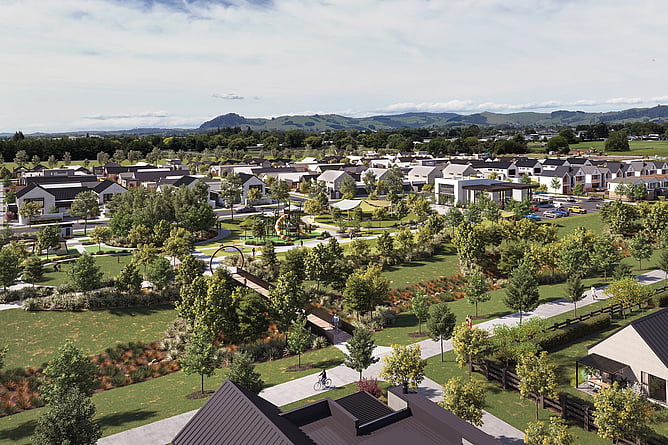
That’s the lens local developer Matt Smith brings to his latest development, Bridleways, a neighbourhood taking shape on the northern edge of Cambridge, where growth, infrastructure and daily life meet in very real ways.
Matt has been developing in Cambridge for more than 30 years. It’s where he grew up, where his children have gone to school, and where he still lives today.
“This is my home, my town,” he says. “Because of that, there’s a huge responsibility on us to get the development of our town right.”
Bridleways sits at one of Cambridge’s key entry points, helping shape first impressions of the town.
“It’s one of the first parts of Cambridge people experience,” Matt says. “You can see the care that’s gone into the way homes have been built, and the pride people take in where they live.”
Matt believes the edges of town matter as much as the centre. New neighbourhoods quickly become part of the town’s identity, shaping how people feel about where they live and how the town is growing. That’s why early investment in infrastructure is so important to him.
“We’ve invested heavily in the basics at Bridleways,” he explains. “Roads, walking and cycling ways, tree networks through the subdivision. You can walk into town, you can cycle into town.”
It’s a deliberately practical approach. Matt isn’t interested in buzzwords or trends. He talks instead about movement and how people actually live, travel and connect in their day to day lives.
“A lot of people talk about growth as if it’s abstract,” he says. “But growth is lived. It’s school runs. It’s sport. It’s trying to get across town at the wrong time of day.”
For him, transport is the pressure point Cambridge can’t afford to ignore.
“If there’s one thing that’s really going to hold Cambridge back, it’s that.”
That reality sits at the heart of how Bridleways is being developed. The focus isn’t just on houses, but on the systems that support daily life: collector roads, formed streets, and integrated walking and cycling connections that reflect where people actually need to go from day to day.
“It’s not just roads,” Matt says. “It’s how those roads work together, and how people can
move safely without needing to jump in the car for everything.”
That thinking extends to how homes are built. Bridleways is designed to be flexible, allowing buyers to work with the development’s main build partners or their own architect, designer or local builder.
“There’s an opportunity here to support local builders and suppliers,” Matt says. “People who care about their homes, and who often build to a baseline that’s higher than what the building code requires.”
“We’re also very conscious that things are getting more expensive, including power, fresh water and running costs,” he adds.
Homes at Bridleways must include solar generation and rainwater harvesting to reduce long-term costs for families.
“Over time, these homes will be cheaper to run, and that matters,” Matt says.
There’s also a strong emphasis on shared spaces and safety. A large neighbourhood playground is already well used, while connected paths and footpaths link key destinations, including the Te Awa cycleway, the town, and a future school site. Planned local amenities will support daily needs closer to home.
All of it comes back to one underlying idea: building where you live changes how you
approach development.
“Cambridge is a relatively big town,” Matt says. “But you can’t hide. You’re judged on what you
build and how you behave. You’ve got to be able to walk down the street and front what you’ve done.”
That accountability shapes his long term perspective.
“We’re very much focused on legacy,” he says. “We know we’re going to be here today, tomorrow, and into the future.”
Importantly, Bridleways isn’t framed as a finished product. It’s part of Cambridge’s ongoing growth story, unfolding in real time, with real constraints on infrastructure costs, transport pressures, and the challenge of making decisions early enough to avoid bigger problems later on.
“We’ve got stock here, ready for people to build on,” Matt says. “The focus should be on finishing what’s been started, and making sure the investment that’s been made actually delivers value for the whole community.”
It’s a pragmatic stance rather than an ideological one. Growth itself isn’t the issue. Unmanaged growth is.
Bridleways aims to apply that lesson in today’s growth reality, where the cost of getting it wrong lasts far longer.
A stunning Cambridge neighbourhood, Matt believes, isn’t defined by how it looks on opening day. It’s defined by how it works - how easily people move, how comfortable homes are, how neighbours interact, and whether the place still feels unmistakably like Cambridge as it settles.