How Ngāti Koroki Kahukura kaumātua Harry Wilson tends the history beneath Cambridge’s newest developments, and why he says the land must be acknowledged before the building can begin.
Long before Cambridge was Cambridge, it was Horotiu Pa, built by the infamous ancestor Koroki. It was the central hub to the Kīngitanga, with gardens as far as the eyes could see. And long before the roads, the roundabouts and the retirement villages, there were people who knew every bend of the Waikato River, and every story carried on the wind from Maungatautari.
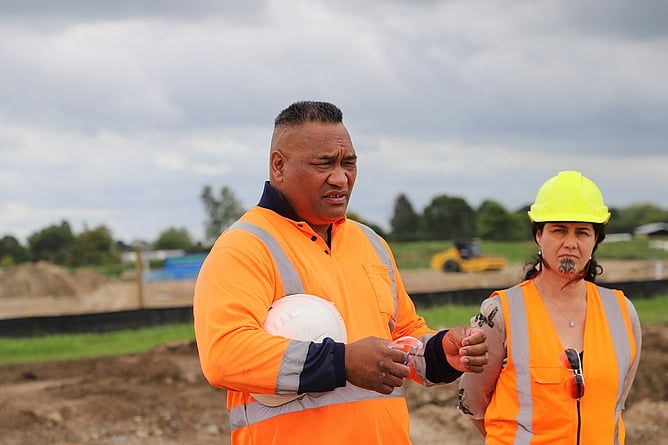
Harry Wilson knows those stories. As a kaumātua for Ngāti Koroki Kahukura, he is the living thread between that world and this one; 26 generations deep in a rohe that most people drive through without knowing its history.
“My role in blessing an area and being able to pass it on to developers or to people is to offer them historically what used to be on the land there,” Harry says. “The narrative around that particular place is pretty important when we are building infrastructure. We need to address the history first.”
What most people don’t realise, he says, is just how central this area was to Māoridom. The land around Cambridge and Lake Te Koo Utu was a central hub, a place of plentiful crops and abundant fish, where people came to rest, to gather, and to resolve their differences. Around 20,000 people once called it home.
History is not always easy. Cambridge’s Museum now stands on what was once the site of the country’s first Native Land Court. From 1866 to the early 1900s, the court processed the fate of Māori land titles here, a system widely understood to have been stacked against Māori. When people came out of those hearings broken-hearted, it was the second Māori King, Tāwhiao, who would take them to the shores of Lake Te Koo Utu. Unable to change the outcome of the court, he offered the only thing he could, a blessing with the water, to relieve their sorrows.
Harry carries that weight with him whenever he performs a karakia. Among many, he has blessed Cambridge Resthaven, Ryman’s new Patrick Hogan Village on Cambridge Road, and led the ceremony for the start of the new expressway section from Cambridge to Piarere, where a kārearea, the New Zealand falcon, now stands as an installation. “The Bird of Peace - Ngāi te Uru Manu,” Harry calls it.
In Te Ao Māori, blessings work across two worlds, the physical and the spiritual. A karakia clears residual energy from land that has been built on, lived on, grieved on. “It’s basically asking permission to use the space again,” Harry explains. The night before the blessing, he receives tohu (signs) associated with the area to make sure it is culturally safe.
Harry’s mother and grandparents instilled in him a simple truth: You can’t change what happened in the past but you can help build what comes next. Telling these stories helps with the healing for Ngāti Koroki Kahukura.
What does he hope that the next generation inherits?
“Unity,” says Harry without hesitation.
It is, both ancient and quietly progressive, an invitation to build something new on our grounds while acknowledging the past.